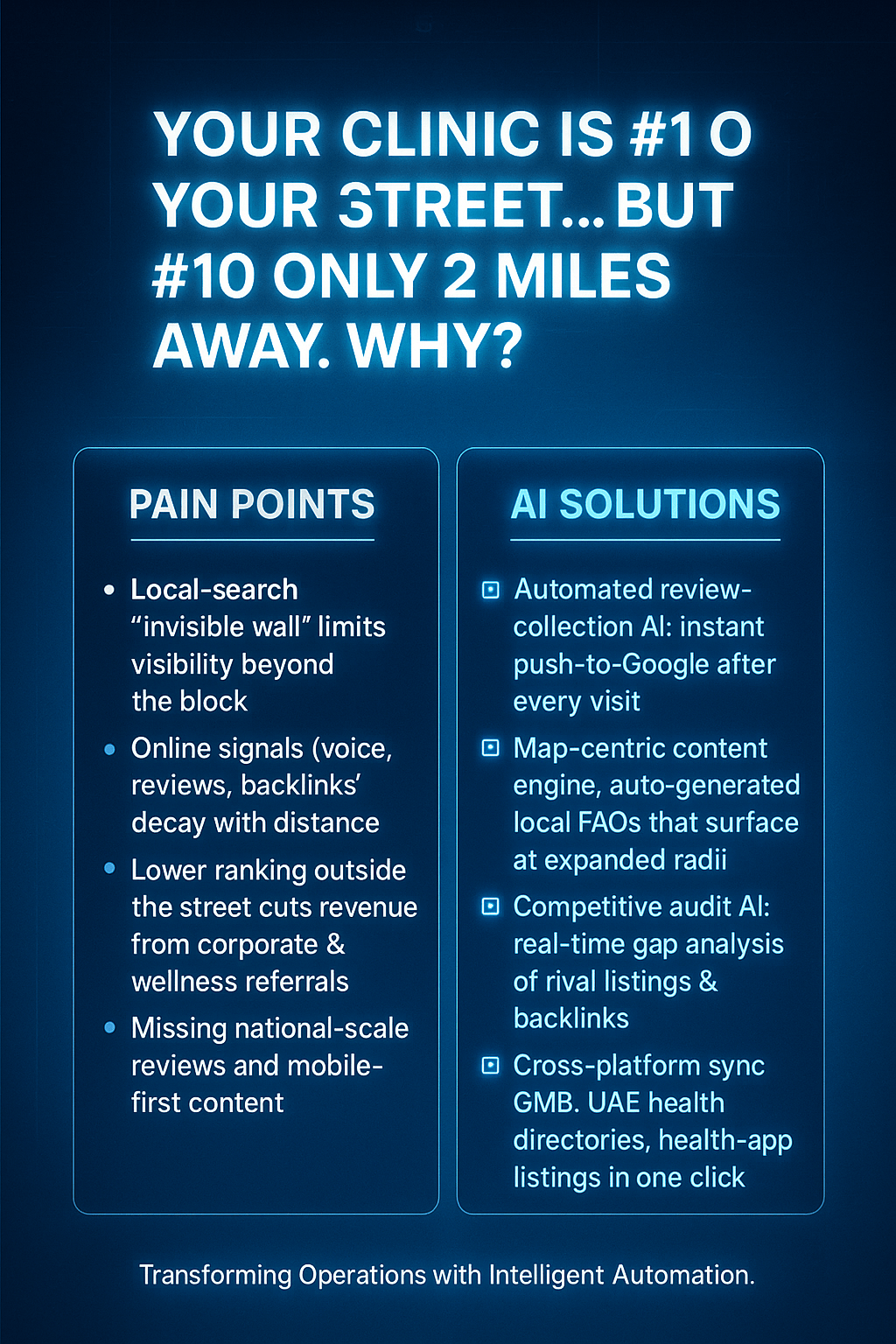
Your clinic is #1 on your street, but drops to #10 just 2 miles away. Why?
When you look at Google Maps from your front door, your clinic sits at the top of the list. Step just a couple of kilometres away and that same clinic slides down to the tenth spot. The reason isn’t random – it’s the way Google’s local‑search engine builds invisible “walls” around you.
1️⃣ The “invisible wall” of local search
Google’s map listings aren’t a single flat list. They slice the world into neighborhoods, then streets. A clinic that dominates its immediate street gets weighted heavily when a resident searches “eye clinic near me” from their door. But a corporate executive searching from a café 1.5 km away uses a broader radius. The algorithm then pulls in clinics with higher overall review volume, stronger claims of medical‑insurance facilitation, or better mobile‑friendly content. If your clinic has a stellar street‑level presence but fewer national reviews, those distant queries behave differently.
2️⃣ Online signals that travel farther
Voice search and “near me” queries stretch wider than the GPS radius. If your competitors are linking to professional bodies, have newer content, or are actively promoted by local influencers, they’ll surface higher when the distance threshold widens. The same physical location can look like an unseen competitor in a 3‑km test, even while it rules the block.
3️⃣ Why this matters for revenue
A lower ranking outside your immediate block isn’t just a vanity metric—it cuts off potential revenue streams. Clinic bookings for follow‑up surgeries or cosmetic procedures often come from corporate wellness programs and reference clients that live or work a few kilometres away. If a patient sees a #10 on their mobile map, they’re 70 % less likely to click and 60 % less likely to book. Automating your local SEO review request workflow, speaking to key stakeholders, and syncing your listing across Google My Business, UAE health directories, and key health apps can move that ranking up without you lifting a finger.
Turn the invisible clinic into a visible revenue engine
- Automate review collection: Use AI‑driven surveys and instant push‑to‑Google after every appointment.
- Map‑centric content: Deploy auto‑targeted local FAQs that surface when the radius expands.
- Data‑driven competitive audit: Let AI scan competitor listings for gaps you can fill in a simple spreadsheet.
Want a clinic that’s #1 everywhere your patients search? If you want this level of automation for your business, visit aiingo.com.